



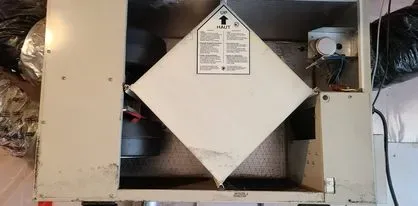
Most Minnesota homeowners have an air exchanger and most of them forget it exists. It quietly cycles stale indoor air out and fresh outside air in — until it gets clogged with dust, leaves, hair, and mold. Then it stops doing its job and starts circulating the problem instead.
The good news: cleaning it yourself takes about 20 minutes, once a year during spring cleaning.
What Is an Air Exchanger?
An air exchanger (also called an HRV — Heat Recovery Ventilator — or ERV — Energy Recovery Ventilator) is typically a white or grey box mounted in your utility room, laundry room, or mechanical room. It has three to four insulated tubes coming out of it. If you have a finished basement, it may be tucked behind a wall access panel.
Its job is ventilation: exhaust stale, humid air from kitchens and bathrooms while recovering heat from that outgoing air and transferring it to fresh incoming air. In Minnesota winters, this is how your house breathes without losing all its heat.
Before you do anything: Unplug the unit. This is important. Air exchangers have moving parts and electrical components. Don't skip this step.
How to Clean It
- Locate the unit — utility room, laundry room, or mechanical area. Look for the box with insulated tubes.
- Unplug it completely before touching anything inside.
- Find the access panel — most units have a door or panel that opens to reveal the filters and core.
- Remove the filters — they slide out. These are typically foam or mesh filters and they will be dirty. Wash them in warm soapy water, rinse well, and let them dry completely before reinstalling.
- Remove and inspect the core — the core is the heat-exchange element, usually a square block that slides out. Vacuum it gently with a brush attachment. Do not use water on the core unless your manufacturer specifically says you can.
- Vacuum the interior — remove any visible dust, debris, or cobwebs from inside the unit housing.
- Check the exterior vents — go outside and locate the intake and exhaust vents. Clear any debris, bird nests, or blockages. These are usually round or rectangular vents on an exterior wall.
- Reinstall filters and core, close the panel, plug the unit back in.
What You Might Find
Don't be surprised if you find a significant buildup of dust, leaves, lint, and — in humid homes — mold on the filters. Air exchangers that handle bathroom exhaust are particularly prone to mold growth because they're cycling humid air. This is normal. It's why annual cleaning matters.
If you find heavy mold growth on the core itself (not just the filters), that's worth having inspected professionally. The core is expensive to replace and mold on it means spores have been circulating through your ventilation system.
How Often
Check filters every 3 months. Full cleaning — filters, core, exterior vents — once a year. Spring is a good time because you're already in cleaning mode and the heating season just ended.
Questions about your home's air quality beyond the exchanger? We're happy to talk through what a duct cleaning might address — call anytime.